Early-Stage Breast Cancer Diagnosis — Computer Vision
Mass and calcification detection on mammograms together with BI-RADS classification
Supported by the Republic of Türkiye Ministry of Health & TÜSEB
National Finalist — Top 50 Among 5,000 Projects

Project Details
- Category: AI in Healthcare — Computer Vision
- Tasks: Mass & Calcification Detection, BI-RADS (Image) Classification
Mass Detection F1 Macro
>90%
Calcification F1 Macro
>90%
BI-RADS 1,2,4,5 F1 Macro
>90%
Summary & Originality
In this project, a decision-support system was developed for the early-stage diagnosis of breast cancer. The solution covers the BI-RADS risk classification used by physicians as well as the detection of suspicious masses and calcifications; in both tasks, success rates above 90% are achieved.
For the detection tasks, YOLO was used with ABC-based hyperparameter optimization.
For the classification tasks, a negative-based collective learning approach was applied on EfficientNet-B1.
This approach was observed to outperform standard classification setups in the literature, and the findings are being prepared as a paper.
Architectural Components
- ROI Cropper: Using Faster R-CNN to feed only the regions of interest (ROI) to the model; eliminating unnecessary areas.
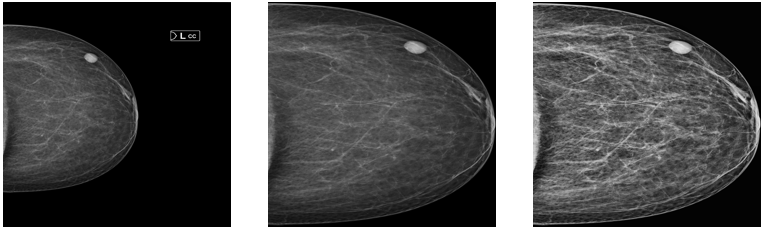
- Preprocessing: DICOM (DCM) → PNG conversion; resizing (classification: 256 px, detection: 640 px); CLAHE to improve lesion-detection performance; data augmentation (90° rotations).
- Density Classifier: Separating mammograms into A/B/C/D densities; training the detection and classification models specifically per density.
- Detection: Detection of masses and calcifications using separate YOLO models for A/B/C/D and ABC-based hyperparameter optimization.
- BI-RADS (Image) Classification: Evaluations across VGG16, InceptionV3, ResNet, EfficientNet, and DenseNet variants; neutralizing the adverse effect of different densities on model performance; original and innovative BI-RADS classification with a Negative-Based Collective Learning architecture trained on EfficientNet-B1.
- Optimization: Tuning YOLO hyperparameters with ABC for detection; a broad search space + Random Search for BI-RADS and density classification.
Technology Stack
Python
PyTorch
YOLOv10
Faster R-CNN
OpenCV / CLAHE
CUDA
RTX 4090
ABC (Hyperparameter)
DenseNet / ResNet / EfficientNet
Datasets Used
- BI-RADS, Mass, Calcification: Ministry of Health 1,000-Patient Mammography Data (BI-RADS 1-2-4-5)
- ROI Cropping: ROI-derived set from RSNA Breast Cancer Detection
- Density & BI-RADS: RSNA public data (~25k density-labeled, ~26k BI-RADS 1–2).