Nahıl AutoML
Task-specific, end-to-end automated AI design framework — theoretical architecture and components
Project Info
- ✓Category: AutoML & Meta-learning
- ✓Scope: Data prep, architecture search, activation & loss design, weight init, hyperparameter optimization
- ✓Status: Theoretical framework and prototype components
Theoretical Framework
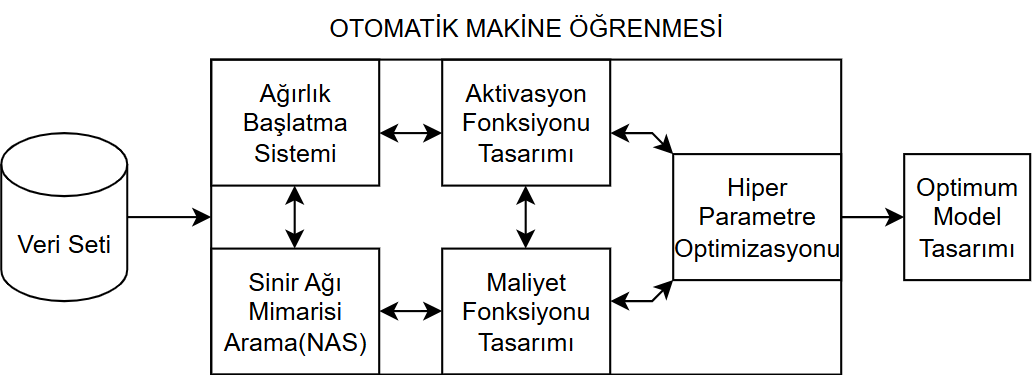
Nahıl AutoML is a high-level automation architecture that designs task-specific ML/DL systems without human intervention. It unifies data preparation, architecture search (NAS), activation and loss design, weight initialization strategies, and training hyperparameter optimization. Components are optimized together with their interactions in mind.
1) Data-driven decisions
Scaling, normalization, class imbalance handling, augmentation, and feature selection are automated from dataset statistics and task type. These constraints guide the downstream searches.
2) Architecture search (NAS)
Search space covers layer types, channels, kernel sizes, connectivity, and regularization choices. Fitness can target low cost, high performance, or a hybrid. Candidates are evaluated with early-stopped trials and chosen on the validation split.
3) Activation & loss design
Activation and loss functions are discovered with semantic-aware operators or adapted by parameterizing known functions. Decisions emphasize outlier robustness, gradient stability, and generalization.
4) Weight init & training hyperparameters
Initialization strategies (He/Xavier variants, scaling tweaks) and training hyperparameters (epochs, learning rate, batch size, etc.) are optimized in a shared search space for faster convergence and smoother loss surfaces.
5) Joint search & multi-objective optimization
Components are evaluated together. Accuracy/F1, parameter count, FLOPs, latency, and memory guide selections that respect deployment constraints, reporting Pareto-optimal solutions.